Mercury to Gold: What if gold could be manufactured in a laboratory instead of being extracted from mines? An American startup has brought this possibility into focus after claiming that it successfully converted mercury into real gold. San Francisco-based Marathon Fusion announced on October 21, 2026, that its experiment achieved a production rate 10 times higher than CERN’s reported benchmark in 2025.
The announcement has attracted attention from scientists, investors and jewellery buyers. With lab-grown diamonds already available at considerably lower prices than natural diamonds, many are wondering whether gold could follow a similar path. However, Marathon Fusion has not disclosed how much gold it produced or what the experiment cost. Independent verification of its latest claim is also pending.
What Has Marathon Fusion Claimed?
Marathon Fusion is an American startup working on nuclear fusion technology. The company is exploring whether future fusion power plants could earn additional revenue by producing valuable materials alongside electricity.
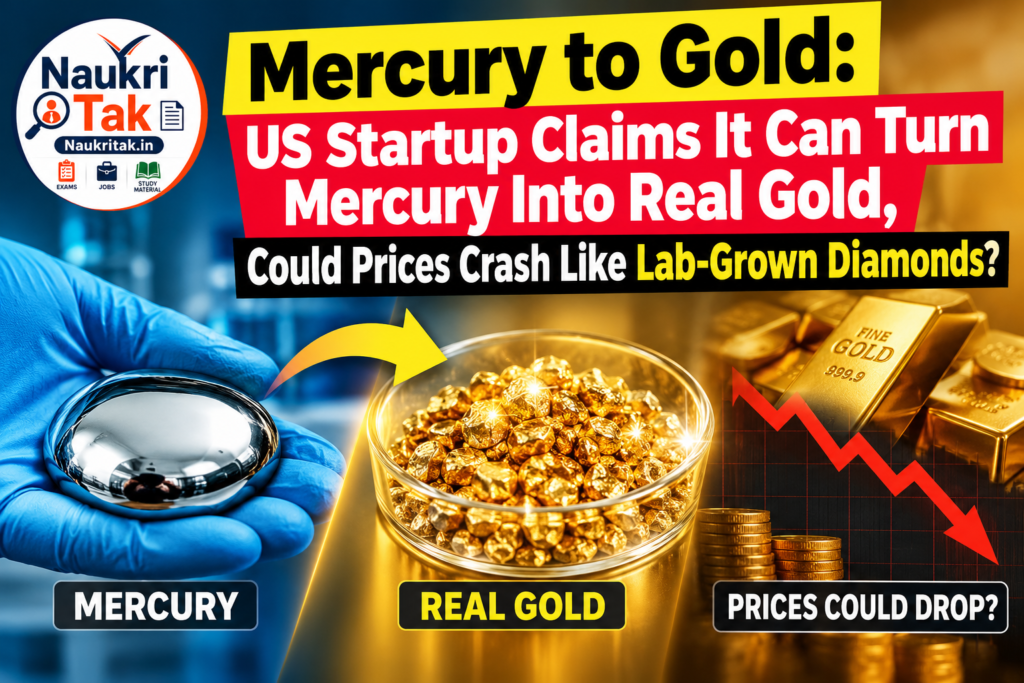
On October 21, the company announced that it had converted mercury into stable gold during an experiment conducted in September. It shared gamma-ray measurements that it said indicated the presence of Mercury-197 and Gold-197, two isotopes involved in the proposed process.
However, the company has not released complete experimental findings establishing the quantity or purity of the gold produced. Its announcement should therefore be treated as an experimental claim rather than evidence of commercial gold manufacturing.
Marathon Fusion Mercury to Gold: Key Details
| Company | Marathon Fusion |
| Country | United States |
| Announcement Date | October 21, 2026 |
| Technology | Nuclear Transmutation |
| Starting Material | Mercury-198 |
| Target Product | Gold-197 |
| Claimed Production Rate | 10 Times CERN Benchmark |
| Projected Annual Output | 2,000 kg per GW Thermal |
| Commercial Production | Not Established |
| Independent Verification | Pending |
How Can Mercury Be Converted Into Real Gold?
For centuries, people searched for ways to turn ordinary metals into gold. Traditional chemical experiments never succeeded because changing one element into another requires altering its atomic nucleus. Mercury contains 80 protons, while gold contains 79. Ordinary chemical reactions cannot change this number, but nuclear reactions can transform one element into another under suitable conditions.
Marathon Fusion’s proposed technology uses high-energy neutrons generated through nuclear fusion to convert Mercury-198 into Mercury-197, which subsequently decays into stable Gold-197.
How the Process Works
- Neutron generation: Nuclear fusion produces high-energy neutrons capable of interacting with mercury nuclei.
- Mercury conversion: These interactions can transform Mercury-198 into radioactive Mercury-197.
- Gold formation: Mercury-197 undergoes radioactive decay, producing stable Gold-197.
- Purification: The resulting gold must be separated from mercury and other unwanted materials before commercial use.
Gold-197 is the same stable isotope found in naturally occurring gold. Properly purified gold produced through this method would therefore have the same chemical properties as mined gold.
Can Marathon Fusion Produce 2,000 kg of Gold Every Year?
One of the most discussed figures in Marathon Fusion’s research is its estimate that a future nuclear fusion reactor could produce approximately 2,000 kilograms of gold annually. The projection comes from a scientific paper published in 2025. Using computer simulations, the researchers estimated that a specially designed reactor operating at one gigawatt of thermal power could potentially manufacture around two tonnes of gold each year.
However, this remains a theoretical estimate. Marathon Fusion has not demonstrated commercial production at this scale or disclosed a verified manufacturing cost. The company believes selling gold alongside electricity could make future fusion power plants more profitable. Whether that becomes practical will depend on reactor performance, operating expenses and the availability of suitable mercury isotopes.
CERN Also Produced Gold in 2025
Marathon Fusion is not the first organisation associated with producing gold through nuclear reactions. In May 2025, CERN announced that scientists at the Large Hadron Collider had observed gold nuclei forming during experiments involving high-energy lead nuclei. Researchers estimated that approximately 86 billion gold nuclei were created between 2015 and 2018. Despite the enormous number, their combined mass was only about 29 picograms, far too little for practical use.
Marathon Fusion is pursuing a different approach involving mercury instead of lead. Although it claims a production rate 10 times higher than CERN’s benchmark, the basis of that comparison has not been fully established publicly. Producing tiny quantities of gold in scientific experiments is still very different from manufacturing enough metal for jewellery or investment bars.
Could Lab-Made Gold Crash Prices Like Lab-Grown Diamonds?
Lab-grown diamonds have become much more affordable as manufacturing techniques improved and production expanded. Their growing availability has put pressure on prices in parts of the diamond industry, prompting comparisons with artificially produced gold.
However, gold presents a much greater manufacturing challenge. Diamonds can be grown from carbon under controlled conditions, while producing gold from mercury requires nuclear transformation, specialised equipment and substantial investment.
Gold also serves as an investment asset and is held in central bank reserves. Its price depends on several factors beyond mining production, including interest rates, investor demand, currency movements and global economic conditions.
What Could Prevent Artificial Gold From Becoming Cheaper?
- High construction and operating costs of nuclear fusion reactors.
- Limited availability of Mercury-198, which makes up about 10% of naturally occurring mercury.
- Expensive isotope separation and purification processes.
- Possible radioactive byproducts requiring specialised treatment.
- The need for large-scale production before global supply is significantly affected.
Until these challenges are addressed, there is little reason to expect an immediate collapse in gold prices.
How Much Gold Does the World Produce Annually?
Global production figures help put Marathon Fusion’s proposal into perspective. According to the World Gold Council’s January 2026 report, worldwide gold mine production was estimated at approximately 3,672 tonnes in 2025. By comparison, Marathon Fusion’s projected annual production of two tonnes from one proposed fusion reactor would represent only around 0.05% of that amount.
Even if the technology achieves its estimated capacity, one facility would contribute relatively little to global supply. A meaningful market impact would require numerous commercial reactors producing gold consistently at competitive costs, something that has not yet been demonstrated.
Will Lab-Made Gold Affect Gold Prices in India?
India is one of the world’s largest gold-consuming countries, where the metal remains important for weddings, festivals, household savings and investment. Any technology capable of increasing global gold supply could eventually influence the Indian market.
However, domestic gold prices depend on more than international production. The rupee-dollar exchange rate, import duties, taxes, jewellery demand and global economic conditions all play important roles.
There is currently no evidence that Marathon Fusion’s experiment will directly reduce gold prices in India. For buyers, the announcement is an interesting scientific development rather than a reliable sign that jewellery prices will soon fall.
Frequently Asked Questions
Has Marathon Fusion Really Turned Mercury Into Gold?
Marathon Fusion claims that it converted mercury into stable gold during an experiment in September 2026. However, independent verification remains pending, and the company has not disclosed the actual quantity produced.
Is Marathon Fusion Producing 2,000 kg of Gold Annually?
No. The figure is a theoretical estimate for a proposed fusion reactor, not an established commercial production result.
Can Lab-Made Gold Be Used in Jewellery?
Properly purified Gold-197 would be chemically identical to natural gold, but the material would need to meet applicable purity and radiation-safety standards before commercial use.
Will Artificial Gold Make Gold Cheaper?
That remains uncertain. Production costs, commercial viability and the technology’s ability to increase global supply have not been established.
Why Gold Buyers Should Not Expect an Immediate Price Crash?
Marathon Fusion’s announcement has renewed interest in producing genuine gold without traditional mining, but the technology still faces considerable practical challenges. The company must establish how much gold its process can produce and whether manufacturing costs would make it commercially worthwhile.
As of October 23, 2026, commercial-scale production has not been demonstrated, and the projected annual output remains theoretical. Until the process becomes commercially viable, global demand, existing gold supplies and economic conditions will continue to play a much bigger role in determining gold prices.